STAZZI AD ARZACHENA
Realization: Filigheddu Costruzioni (Porto Cervo)
“The conservation and renovation of an antique stazzo, or sheep fold, and the construction of a second building completely in harmony with the existing one created an exquisite complex of buildings, positioned in the landscape with sensitivity and sense of balance.”
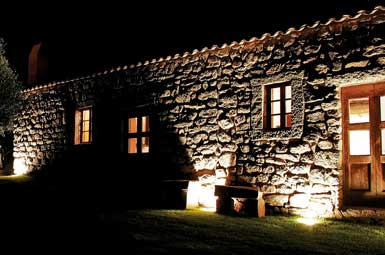
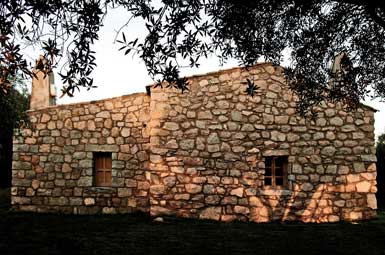
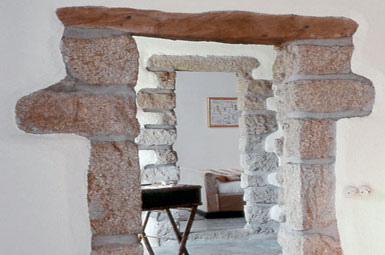
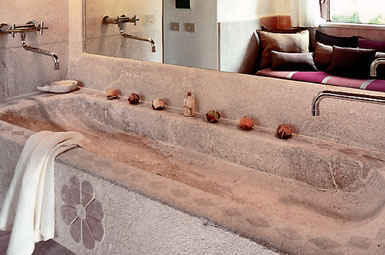
There are times when an architectural design must not invent anything, but instead should conform to the given model. This approach is essential for consummately simple constructions, for example the type of dwelling called stazzo, typical of the Gallura region, which from the 18th century on has been a feature of these agricultural settlements. Situated in isolated places and positioned to have a commanding view over the flocks, stazzi have over time attracted the attention of lovers of Sardinia’s interior. The project illustrated in these pages is located in Arzachena, not far from the mushroom-shaped granite mass that has long been a symbol of the town. The plot of land, found at the edge of the settlement, already had a construction on it, and another was newly built nearby. Together they form a complex of great beauty, fitting into the landscape harmoniously and respectfully. The task taken on by Filigheddu company was twofold: the conservation and renovation of the existing structure and the design and construction of the new building. The restoration was carried out with an authoritative knowledge of the construction techniques used in times past. Nearly all was brought back to its original state, respecting the volumes, proportions, and the materials. Traditionally, the structure was built to house just one family at first and was then later enlarged, while still maintaining its formal characteristics (pitched roof and rectangular plan), when it became necessary to house a second family, as seen in the construction restored here. The wall that separated the two portions has now been opened, maintaining the different floor levels, to connect the night and day zones. The roofs are those of the time, with juniper beams (taken down, sandblasted, and put back in place) resting on granite corbels, and with reed laths that guarantee a natural insulation. All the blocks of granite serving as architraves over the windows and those placed around the perimeter of the door-less passages between the different rooms are original. What was once a bare dirt floor is now concrete, decorated in some of the corners of the living room with inlaid Adularia stones, at the homeowner’s request. In what was once the kitchen, called the pinnenti, there now stands a bathroom that offers eloquent testimony to the skills of the contractors and their stonecarvers. The walls are lined with single slabs of Orosei stone, while a washbasin of remarkable size, stretching between the two walls, was carved from a block of the same marble, then bushhammered, leaving small areas in their natural state to form simple floral motifs. The construction of the second stazzo was taken on with such great skill that only an expert eye could detect at first sight which of the two buildings is the more recent one. The exterior displays the same irregularly shaped blocks of granite that the place’s inhabitants used to collect in the meadows. The intention was not to imitate the old, but to recreate it through careful choices, from the use of hefty juniper beams and reed laths for the roofing, to the thickness of the walls, the design of the apertures, the interior layout, which, while still answering modern needs, maintains traditional proportions. In this second house, too, the stone is worked with extraordinary skill. The floors are in large slabs of bushhammered Orosei marble, creating a neutral and elegant face; the kitchen is dominated by very thick work surfaces from which the sink was carved out, and the bathroom has a sink that was carved from a single stone block with such mastery as to make the material seem soft and malleable. There is no sense in taking something that reflects contemporary needs and making it look “antique”, so the explicitly modern project’s choice to add a circular swimming pool overlooked by the two buildings is a coherent one: an act of boldness that did not seek to imitate nature or create a fake pond or the like. It was designed to have a round shape, only slightly flattened, with a flow of water over the band of Orosei marble that marks its perimeter and complements the elegant pavement in marble and granite slabs of yellow Arzachena granite.